EGR Valve Problems
What are the symptoms of a failing EGR valve?
Now if you are completely new to the world of cars, or if you Have not spent much time tinkering around with your toys, you may not have heard of a EGR Valve.
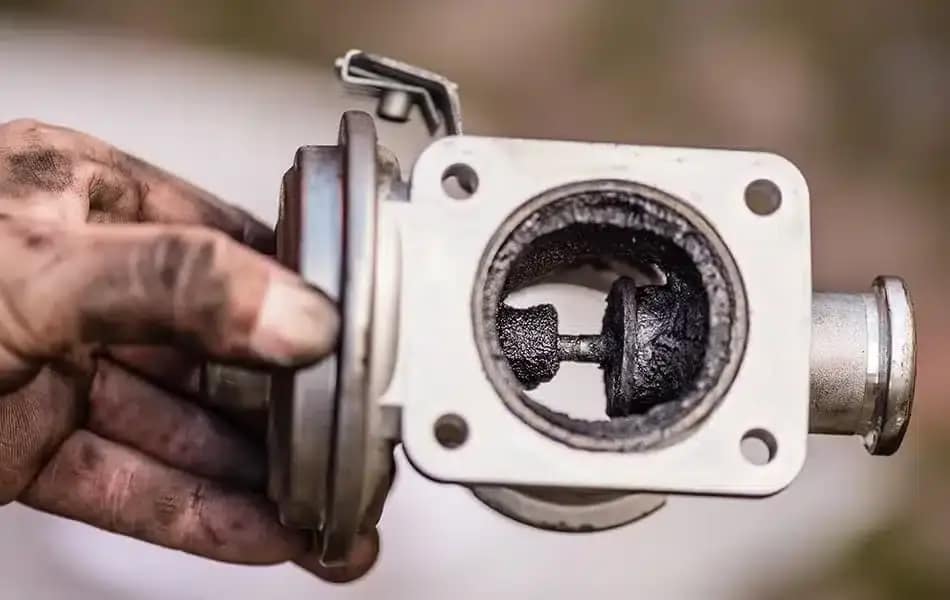
Clogged up EGR Valve needs cleaning
This is where most mechanics may try to take advantage of the vehicle owners. But don’t worry, we’ve got you covered and this article will help you understand.
- Your engine has a rough idle. …
- Your car has poor performance. …
- You have increased fuel consumption. …
- Your car frequently stalls when idling. …
- You can smell unburnt fuel. …
- Your engine management light stays on. …
- Your car produces more emissions. …
- You Can hear knocking noises coming from the engine.
How you can find if your EGR is actually faulty? and what may be the reason for this? You will also get to know everything there is to know about this simple yet complex vehicle component, so let’s jump right into it a Good Technician will run a Diagnostic Code which will help look for the problem.
5 Symptoms of A Bad EGR Valve?
EGR faults can cause a lot of problems. The fuel economy of the vehicle is hit, for instance, and this will cause high fuel consumption by the vehicle, increasing the chances of more carbon deposits, higher emissions, and faulty injectors and damaged spark PLUGS on petrel vehicles
So it is really essential that you get a faulty EGR checked as soon as possible. While there can be a lot of bad symptoms, the following are the major red signs that tell you your EGR valve is in need of a check-up and cleaning or worse case replacing
1) Poor Engine Performance
There are a lot of issues when it comes to bad EGR valves and the first and perhaps most frustrating problem is the performance of the engine. There is a big chance for you to experience acceleration difficulties and even an overall reduction in the power of the engine when you step on the gas pedal. This can also happen due to bad fuel filter
This can happen due to the air-fuel ratio being heavily rich or heavily lean[1]. It is because of this that the engine may require more fuel than normal in almost every situation you’re facing while driving. This will really take a hit on your wallet as fuel prices aren’t showing signs of reducing only sky rocketting
2) The Engine Warning Light or EML Engine Management Light Dont confuse this with a service due indicater
You must always check the engine indicator which will in most cases glow up on the dashboard if the EGR valve fails in any case(unless you’ve somehow damaged that as well, in which case you’ll need to replace that as well). but the EML warning light can indicate any kind of engine malfunction which is why a decent scanning computer is required to retrieve the fault code
We won’t get too technical here, but just to know that the Engine warning indicator will turn on when the ECU the btain of the car senses any issues with the engine or its directly associated components.
The EGR is directly connected to the engine, and so any irregularities in its functioning(opening, closing, etc.,) will be immediately sensed by the EGR valve sensors.
3) Smell of Unburnt Fuel
Now that the EGR valve is not functioning properly, the engine is taking up more fuel than it is supposed to, which will eventually cause more hydrocarbons to leave the tailpipe. This will increase the amount of fuel odor, and to such an extent that you can feel it inside the car if your AC is not in recirculation mode.
It’s a very irritating phenomenon and can be terrible for your health. This is a sure sign that something is wrong with the engine.
4) A Failed Mot Emissions Test
If you are in a situation that requires you to test for increased emission levels every 6 months, then it might be a chance that you have a faulty EGR valve. Although this test may not accurately predict the state of the EGR, if you fail your emission test, it’s a healthy practice to have the vehicle’s EGR valve checked out by a professional Technician
5) Rough Idling
Rough Idling happens when the engine has a faulty EGR valve. In this case, the valve will remain stuck in either an open or closed position as long as the problem is fixed.
This might also be an indication that there are a few too many exhaust gases entering the combustion chamber.
This will disrupt the air/fuel mixture that’s required for proper idling of the engine. You’ll then notice rpm needle fluctuation as the car struggles to maintain idle rpm.
A EGR valve stuck in an open position creates a vacuum leak that causes inefficient combustion, A valve that’s stuck in a closed position increases nitrogen oxide emissions, which disrupt engine timing, leading to A engine knock.
What is an EGR Valve?
The EGR valve or the Exhaust Gas Recirculation valve can be found in most of the modern fuel-powered vehicles(petrol and diesel), and the purpose of these things is to help reduce engine emissions, by sort of “recirculating” some of the exhaust gas back into the engine.
Over the past few years, it has been proved that there have been drastic changes in climate due to pollution, and the contribution of automobiles to this pollution is very high.
The government has in turn set certain regulations for vehicle manufacturers, and one of them is the addition of the EGR. So almost every vehicle you see on the road today likely has an EGR fitted to the engine.

Merits to an EGR Valve
An EGR valve will reduce the temperatures in the cylinder by considerable amounts. Not getting too technical, here’s a quick working principle on how engines work – they basically take in air and mix it with fuel at a certain temperature and pressure, and this mixture is then ignited to produce energy that moves the wheels of the vehicle.
However, this process creates a lot of heat, and too much heat is never good. With the help of an EGR valve, a portion of the exhaust gas is allowed to pass through the inlet manifold where it displaces a certain amount of oxygen from the air, thus keeping the engine cooler and more efficient.
High temperature and the excess amount of oxygen are the main sources of NOx (pollutant exhaust gas) formation. And from the above observation, it can be clearly stated that an EGR effectively reduces both excess oxygen content and reduces the engine temperature as well.
It also helps in reducing the number of nitrogen emissions produced. Exhaust Gas Recirculation (EGR) is one of the simplest techniques that can be easily applied in a way to suppress NOx formation.
If your experiancing any of these Symtons with your vehicle check out this Garage who will be happy to help you fix your issue.
Contact 01189581198 or email us today repairs@mot-centre.com

